
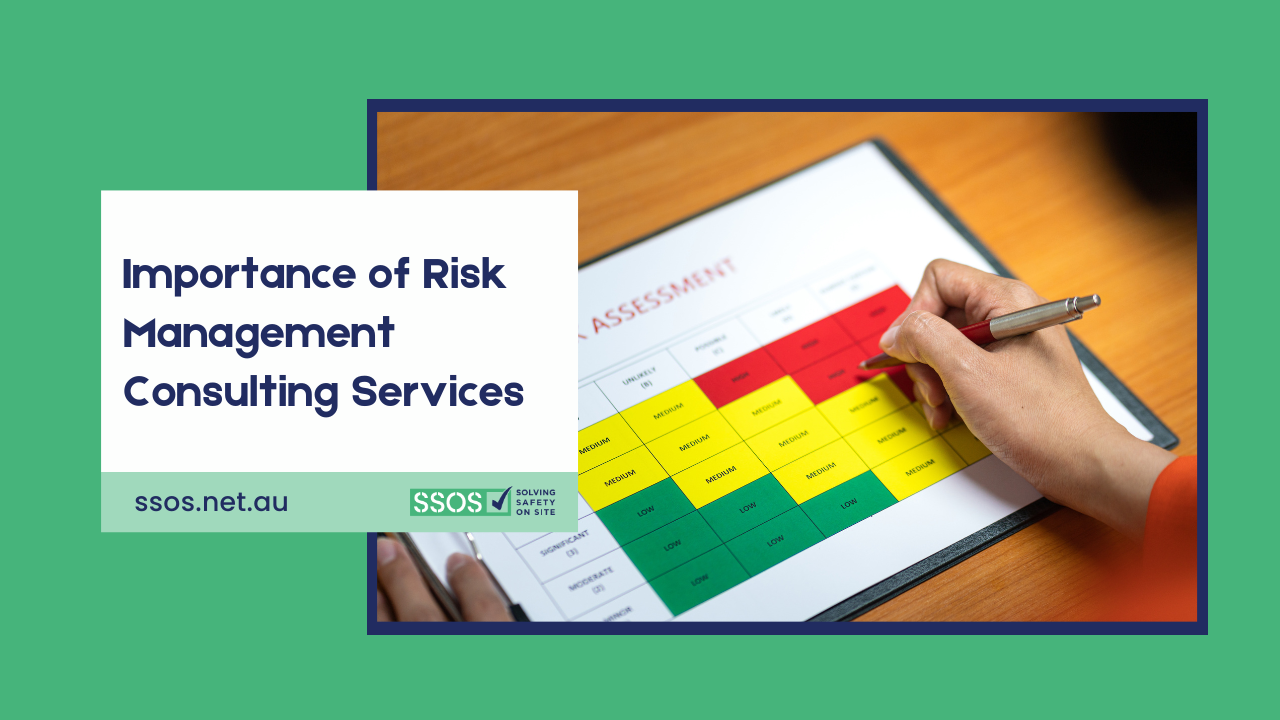
In today's ever-shifting business landscape, companies face more than just market or competitive threats. They must navigate complex regulations, evolving safety requirements and stakeholder expectations. That's why investing in professional risk management frameworks isn't optional; it's essential for long-term resilience.
This article explores why risk management consulting matters, how it helps organisations and when engaging specialists like Solving Safety On Site or other expert advisers can transform your business. It also addresses how you can integrate these insights into your operations and safety culture with strategic purpose.
What risk management consulting actually means
Risk management consulting refers to the advisory and implementation services that help organisations identify, assess and treat risks across their operations. A risk assessment consultant plays a "multifaceted" role — guiding companies through risk analysis, fostering a strong risk culture and helping embed proactive practices.
Risk management also involves identifying potential risks that could negatively impact a business and developing strategies to mitigate or manage them. In practical terms, the work covers everything from operational hazards and compliance gaps to strategic vulnerabilities and reputational threats.
Why businesses must take risk seriously
When you ignore or under-estimate risk, the consequences can be swift and severe. A business may face regulatory penalties, operational disruptions, financial losses or brand damage. Effective consulting helps prevent these outcomes by bringing discipline and foresight.
As stated by businesses that conduct comprehensive risk assessments ensure that their organisation is well-prepared to address them through impact analysis and mitigation planning. Risk management helps businesses comply with regulations and standards reducing the risk of fines and legal issues. Beyond compliance, proactively managing risk offers operational benefits, strategic clarity and improved stakeholder confidence.
Core areas risk consultants cover
In my experience and reflected in published guidance, there are several key domains that risk consultants routinely cover:
- Risk identification: Pinpointing what could go wrong — from safety incidents and process failures to regulatory non-compliance and market shift.
- Risk assessment: Understanding how likely an event is and what its impact would be. Risk impact analysis evaluates the likelihood and severity of various risks.
- Risk treatment or mitigation: Mapping out strategies to avoid, reduce, transfer or accept risks. Most of the businesses emphasise the need to create a "risk mitigation plan" with actionable strategies.
- Continuous monitoring and review: Risk is dynamic, so frameworks must evolve. Constant monitoring and updating of risk strategies are essential.
- Risk culture and governance: Embedding awareness, transparency and accountability into everyday operations. Consultants often help build this tone from the top.
What specialist consulting brings to the table
Engaging expert advisers delivers far more than simply checking boxes. Some of the most compelling benefits include:
- Deep expertise and an external viewpoint: A seasoned consultant is not immersed only in your business, giving fresh insight and uncovering blind spots. Consultants bring a wealth of knowledge and experience that an in-house team might lack.
- Tailored strategies: Instead of generic templates, good consulting aligns with your sector, size, risk appetite and regulatory context. Customised risk management strategies also help to address the business's unique needs.
- Cost-effectiveness: While there's upfront investment, the preventative value often far outweighs the cost of incident, breach or regulatory failure. Cost savings also prevent costly incidents and compliance issues.
- Strengthened decision-making: With a clearer view of threats and opportunities, leadership can steer with confidence and clarity. Enhanced decision-making capabilities mainly derived from comprehensive risk assessments.
- Improved reputation and stakeholder trust: Organisations that manage risk well tend to earn higher trust from customers, regulators, investors and staff.
How consulting supports workplace health and safety
A major thread through risk consulting is its role in health and safety. Whether you operate in construction, manufacturing, services or education, applying a robust risk framework in WHS is non-negotiable. Consultants help you define hazards, measure exposures, set controls and embed monitoring — tasks critical for both compliance and culture. For example, one consulting firm describes the full lifecycle: hazard identification, risk quantification and monitoring control measures.
In Australia and elsewhere, failing to maintain adequate risk processes can lead not just to financial cost but human cost — injuries, illnesses, reputational harm. A consulting partner can elevate WHS from a contractual compliance tick-box to a strategic differentiator.
Integrating consulting into your organisational strategy
When companies embark on risk consulting, success often hinges on how deeply the services are integrated into strategy. Here are practical steps:
- Define the scope: Start by understanding which functions, locations or processes are in focus. Is it the entire organisation or a specific site? Use gap analysis to benchmark the current state.
- Establish leadership buy-in: Risk management must be championed from the top. Encourage executives to consider risk in strategic planning, budgeting and culture-setting.
- Select the right consultant or firm: Look for experience in your industry, credentials in relevant standards (e.g., ISO, OHS), and a reputation for practical, not theoretical, guidance.
- Tailor the solution: Avoid off-the-shelf templates that don't reflect your reality. A consultant should develop tools, policies and procedures customised to you.
- Embed tools and systems: Many firms now combine consulting with software systems or dashboards to track controls, incidents, KPIs and compliance.
- Train and engage staff: A system is never stronger than the people who use it. Staff need to understand risks, controls and reporting mechanisms — and feel safe to speak up.
- Monitor, review and adapt: Risk isn't static. Schedule regular reviews, look for emerging threats (e.g., digital, supply-chain disruption, legislative change) and update accordingly.
Specialist consulting for safety standards
Risk consulting often overlaps with compliance to internationally recognised standards and workplace safety frameworks. For example:
- Firms might assist with certifications such as ISO 45001 (Occupational health & safety management) or ISO 31000 (Risk management).
- Safety and WHS consulting can help organisations meet legal obligations such as those under Work Health & Safety laws or equivalent in their jurisdiction.
- Consultants often provide operational tools such as Safe Work Method Statements (SWMS), incident investigation frameworks, contractor management systems and more.
For an organisation seeking long-term resilience, these standards and processes are more than compliance—they represent competitive advantage.
When you might particularly need specialist WHS or workplace consultation
There are several triggers or indicators that your business should engage consultants:
- You're expanding into new jurisdictions, new operations, or new types of work with different hazards.
- You've had a significant incident, near-miss, audit failure or regulatory notice and you want to get ahead of repeat issues.
- Your board or executive wants better visibility and assurance over risk and wishes to adopt a risk-based management system.
- Your insurance premiums, compliance costs or incident costs are trending upward, signalling weak risk controls.
- You want to embed a mature risk culture rather than just reactive fixes—this might include training, dashboards and continuous monitoring.
- You are bidding for tenders or contracts which require documented systems for risk, safety, and compliance (common in construction, mining, government procurement).
In such cases, engaging professional services makes sound strategic sense.
How to maximise value from risk consulting investment
To get the best return, consider these tips:
- Set clear objectives: Before engaging a consultant, identify what you want: reduced incidents? certification? improved controls? lower insurance premiums?
- Involve stakeholders early: From management to frontline workers, engagement ensures the framework is accepted and lived.
- Monitor target outcomes: Use KPIs — incident rates, hazard reports, audit findings, training completion, control effectiveness.
- Embed accountability: Assign responsibility for risk reviews, action-plans, controls, and ensure they're tracked.
- Use technology: Risk frameworks are greatly enhanced when supported by software platforms enabling reporting, dashboards and trend-analysis.
- Update regularly: Markets, technology, regulation and external threats change. Make frequent review a standard part of your plan.
- Promote continuous learning: Incorporate near-misses, incident investigations and audit findings into learning programs to prevent recurrence.
The broader business benefits beyond safety and compliance
While compliance and safety are critical, risk consulting offers impacts that touch many parts of your organisation:
- Operational resilience: By mapping key vulnerabilities, you reduce downtime and keep operations running smoothly.
- Strategic agility: Understanding risk gives leadership the confidence to pursue opportunities while knowing the guardrails are in place.
- Financial advantage: Fewer incidents, lower insurance costs, better resource allocation – all contribute to improved profitability.
- Reputation and trust: Stakeholders increasingly demand proof of robust risk management. Demonstrating this can assist with investor relations, tendering and customer relationships.
- Culture transformation: A mature risk culture becomes part of how you do things — not an add-on. Employees anticipate, report and act rather than just react.
Bringing everything together: a roadmap to consulting success
Here's a simplified roadmap you can follow when engaging risk management consulting:
- Kick-off & baseline: Engage consultant, review current state (processes, systems, controls, culture).
- Gap analysis: Map your operations versus best practice, standards, legal obligations.
- Risk register and prioritisation: Identify critical risks, assess likelihood/impact, prioritise.
- Strategy development: Develop mitigation plans, control frameworks, policies & procedures.
- Implementation: Deploy controls, train staff, implement software/platforms for reporting.
- Embed culture: Ensure risk is part of daily operations, reporting lines are clear, senior leadership is visible.
- Monitor & review: Set up KPIs, dashboards, incident investigations, continuous improvement loops.
- Audit & certification (optional): For businesses aiming for ISO certification or regulatory assurance, consultant guides you through the audit process.
- Refine & evolve: As the business or external environment changes, revisit risks and adjust.
Concluding thoughts
In a business world where uncertainty is the new normal, effective risk management is no longer a matter of "nice to have" but a strategic imperative. Specialist consultancy helps you move from reactive firefighting to proactive resilience. By deploying structured frameworks, tailored strategies and continuous monitoring your organisation not only complies with regulations but gains competitive advantage, stronger culture, better decision-making and greater stakeholder confidence.
If your business is seeking to raise its bar in health & safety, compliance, operational resilience or strategic risk management, engaging dedicated consulting services is a smart move. Whether you need help with safety systems, enterprise-level risk frameworks or ongoing monitoring, the investment will pay dividends in safeguarding your people, assets and reputation.