
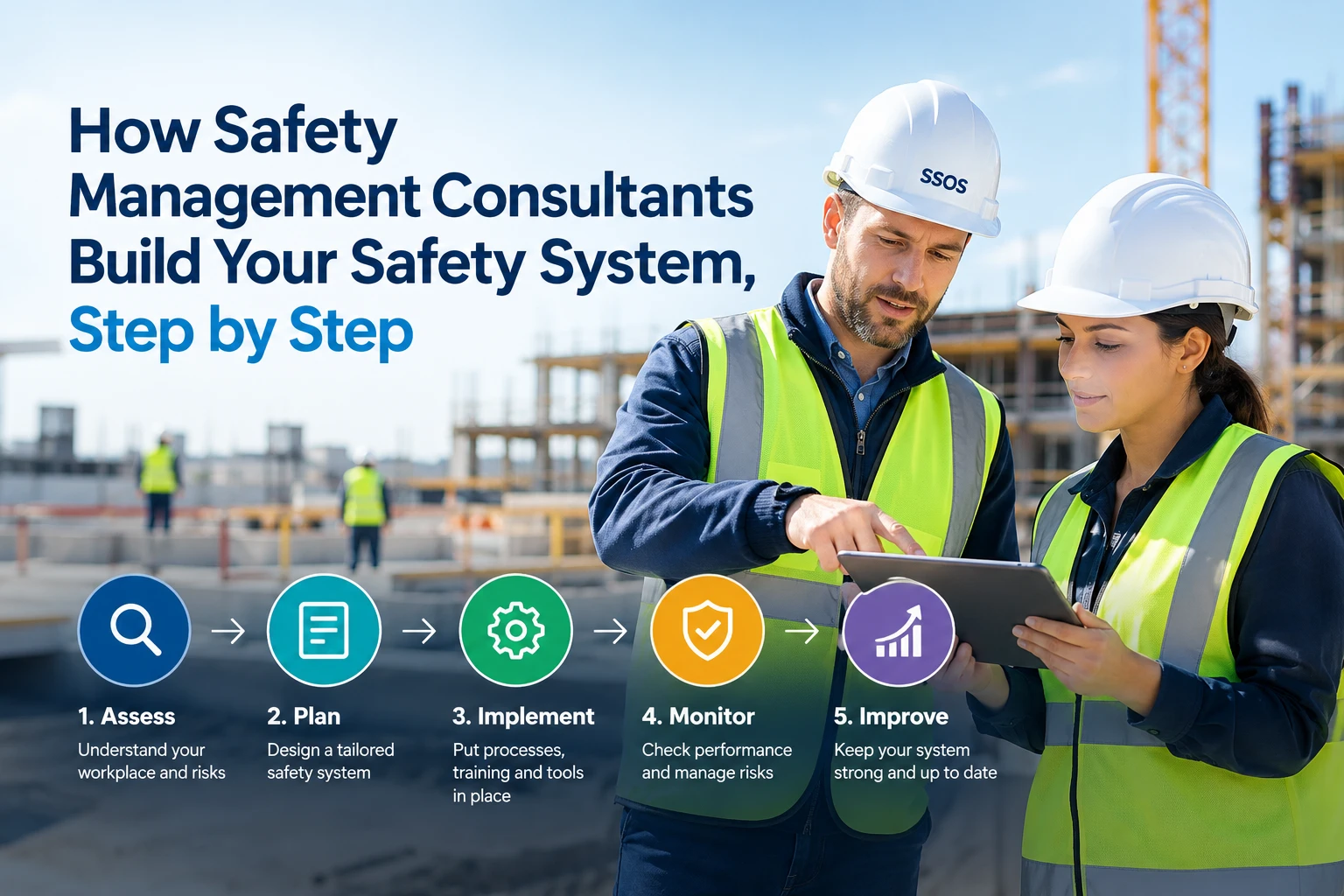
You've decided to get outside help with safety. Now what actually happens? Most owners have no idea what the first meeting looks like, how much of their time it takes, or what they'll have in hand at the end.
Good safety management consultants follow a clear process. They find out what you have, measure it against the law and your clients' requirements, build what's missing, get it working on site, then check it holds up. This guide walks through each stage, what you'll need to provide, and how to get the most from the engagement.
Still deciding whether you need a consultant at all? Start with how a WHS consultant can strengthen your safety management system.
Key takeaways
- The process usually runs in six stages: scoping, gap analysis, system build, site rollout, audit, and ongoing upkeep.
- Bringing your existing documents and client requirements to the first meeting saves the most time.
- The legal duty stays with your business. The consultant helps you meet it but can't take it over.
- A system only works if supervisors and crews use it, so rollout matters as much as the paperwork.
What happens when you hire safety management consultants?
Safety management consultants typically work in six stages. They scope your business, run a gap analysis against WHS law and client requirements, build or rewrite the documents you need, roll the system out on site, audit how it's working, and then keep it current as your projects and obligations change.
Here's the whole process at a glance, including your side of the work:
| Stage | What happens | What you provide | What you get |
|---|---|---|---|
| 1. Scoping | First meeting about your work, sites and goals | Current documents, client requirements | Agreed scope and priorities |
| 2. Gap analysis | Your system is checked against WHS law and client needs | Access to records and a site visit | A prioritised gap list |
| 3. System build | Plans, SWMS, procedures and registers are written or rewritten | Feedback from supervisors | A working document set |
| 4. Site rollout | Crews and supervisors are shown how to use it | Time for toolbox talks and inductions | A system people actually use |
| 5. Audit | What happens on site is checked against the paperwork | Site access | Audit report and corrective actions |
| 6. Upkeep | Documents are reviewed as work and laws change | Updates on new projects or incidents | A system that stays current |
Each stage builds on the last, so it's worth looking at them one at a time.
Step 1: Scoping your business and goals
The first conversation sets the direction for everything else. The consultant needs to understand what you do, where you do it, and why you want help now. Winning a tender, passing ISO certification and cleaning up after an incident all lead to very different priorities.
You'll save time if you bring:
- Whatever safety documents you already have, even if they're old or incomplete
- Prequalification forms or tender requirements from the clients you work for
- A list of the high-risk work your crews do
- Your incident and near-miss records
- Who's responsible for what, even if it's informal
Don't tidy anything up first. The consultant needs to see the real state of things, and that's exactly what the next step measures.
Step 2: The gap analysis
A gap analysis compares what you have against what you need. "What you need" comes from three places: WHS laws, your clients' requirements, and any standard you're aiming for, such as ISO 45001.
The legal baseline is simple to state and harder to prove. Under the model WHS Act, a business must ensure the health and safety of its workers "so far as is reasonably practicable." The gap analysis shows where your records can't yet back that up.
This step matters most in construction. Safe Work Australia's Key Work Health and Safety Statistics Australia 2025 reports that 37 construction workers died from traumatic injuries at work in 2024. The industry also recorded 17,600 serious workers' compensation claims in 2023–24 (preliminary figures). Regulators and principal contractors look hardest at the industries carrying that risk.
Expect a site visit as part of this stage. A system can look complete on paper while the SWMS in the site box are three versions out of date. The result is a prioritised list: what's missing, what needs rewriting, and what can stay.
Step 3: Building or rewriting the system
This is where most of the consultant's hours go. Working from the gap list, they write or rewrite the documents your business needs, starting with the highest-risk gaps.
For a construction business, that usually includes:
- A WHS management plan and safety policy
- Safe Work Method Statements for your high-risk work, plus site-specific risk assessments
- Safe work procedures and an emergency management plan
- Hazard, incident and corrective action forms
- Plant and equipment, training and competency registers
- A contractor management process for subcontractors
- Silica compliance documentation, where your work involves it
Good consultants write for the person reading it on site, not for an auditor in an office. Ask to see drafts and have your supervisors read them. If a leading hand can't follow a SWMS in a few minutes, it needs another pass. Our guide to the must-have elements of a SWMS shows what a usable one looks like.
A finished document set is only half the job, though. It still has to reach the people doing the work.
Step 4: Rolling it out on site
Rollout is where many systems fail. The documents get emailed out, nobody explains them, and crews keep doing what they've always done.
A proper rollout puts the consultant in front of the people who'll use the system. That means toolbox talks on the new SWMS, updated site inductions, and showing supervisors how to fill in inspections and report hazards. It's also the right time to decide whether to stay on paper or go digital.
Digital forms suit crews spread across several sites. When Soldier Tower Cranes moved to Microsoft Forms and SharePoint, it gained digital contractor onboarding and crane inspection systems. The result was less paperwork and faster onboarding. SSOS sets this up through our digital compliance solutions, using QR code forms, mobile inspections and online registers.
Step 5: Auditing what's actually happening
Once the system has been running for a while, the consultant checks it against reality. An internal audit looks at whether SWMS are being followed, whether inspections are done and signed, whether PPE matches what's specified, and whether corrective actions get closed out.
For Formcom, SSOS ran independent site audits across active projects. Those audits covered SWMS implementation, PPE, scaffold, edge protection and housekeeping. Each audit ended with a report and prioritised corrective actions, so the site team knew exactly what to fix first.
Audits aren't about catching people out. They show where the system and the work have drifted apart, which is normal and fixable. If you'd like to run a quick check yourself between visits, our compliance audit checklist is a good place to start.
Step 6: Keeping the system current
A safety system starts going out of date the day it's finished. New projects bring new hazards, clients change their prequalification rules, and laws get updated. SWMS also need reviewing when the work or conditions change. Our post on how often SWMS must be reviewed covers the triggers.
Some businesses handle upkeep in-house once the system is running. Others keep the consultant on for regular reviews, document updates, site inspections and legislative updates. That's what SSOS's ongoing compliance management covers. If you're going for certification, this stage also includes internal audits and management reviews. Those were part of the work behind Fratelli Group achieving Stage 2 ISO certification.
How long does the whole process take?
There's no standard timeline, and you should be wary of anyone who quotes one before seeing your business. The time it takes depends on:
- How much of a system you already have
- How many trades, sites and types of high-risk work are involved
- Whether you're aiming for ISO certification or just compliance
- Deadlines such as a tender closing date or a client audit
- How quickly your team can review drafts and make time for rollout
The fair ask is a staged plan after the gap analysis, showing what gets done first and roughly when.
How to get the most out of working with a consultant
The businesses that get the best results treat the consultant as part of the team, not a document supplier. A few things make a real difference:
- Name one internal owner. Someone on your side needs to chase reviews and approvals.
- Involve supervisors early. They'll spot a procedure that won't work on site before it reaches the crew.
- Be honest about incidents and shortcuts. A gap the consultant doesn't know about won't get fixed.
- Share client requirements up front. It's quicker to build to a Tier 1 builder's checklist than to retrofit it later.
- Ask for editable formats. You'll want to update documents yourself between reviews.
Frequently asked questions
Does hiring a consultant transfer our WHS duties to them?
No. Under the model WHS Act, a duty can't be transferred to another person. Your business stays responsible for health and safety. A consultant helps you meet that duty by building, checking and maintaining the system, but you still have to use it.
Will we have to throw out our existing safety documents?
Usually not. The gap analysis identifies what still works, what needs updating, and what's missing. Many businesses keep a good share of their existing forms and procedures, rewritten so they're consistent and current.
Can a safety system be fully digital?
Yes. Inductions, inspections, incident and hazard reports, contractor onboarding and registers can all run on platforms like Microsoft Forms, Google Forms and SharePoint. Workers can then report from a phone on site, and records stay in one place.
Do workers need training on the new system?
Yes. A system people don't understand won't be followed. Toolbox talks, updated inductions and a walk-through with supervisors are a standard part of rollout.
Ready to start?
The first step is a conversation about where your system stands and what you need it to do. The SSOS team works with construction businesses, civil contractors, crane companies and trades. Get in touch with SSOS and we'll show you what the process would look like for your business before any work starts.
For more background on the role itself, read our guide to what a WHS consultant does, or see how we work as safety management consultants for construction.