
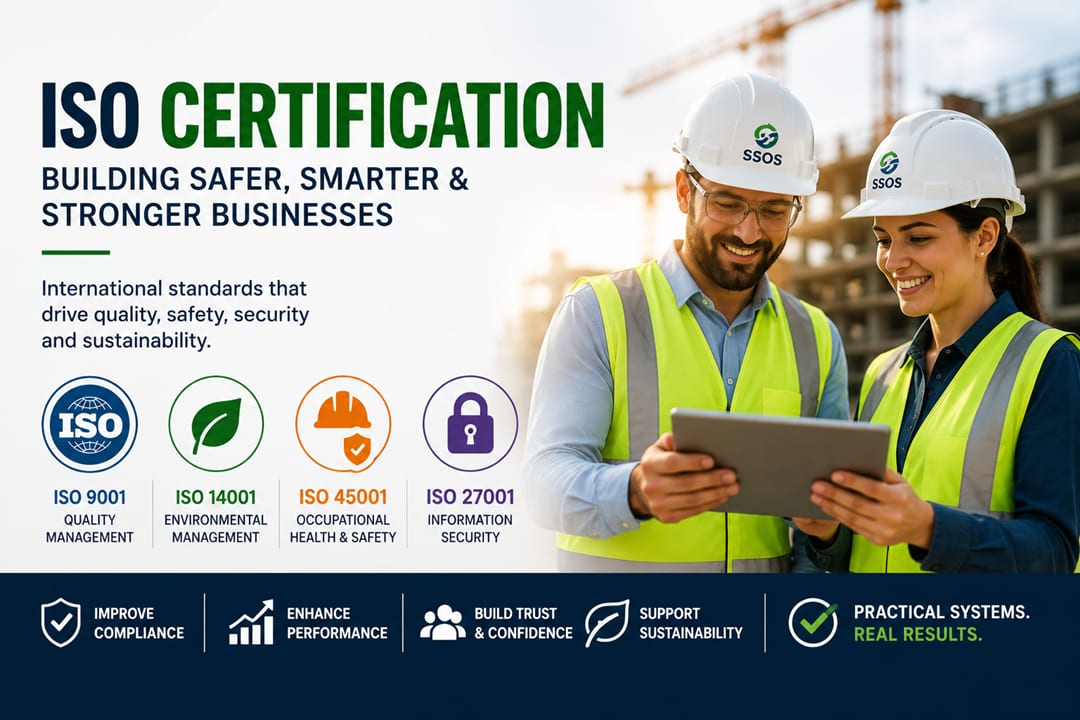
Running a business today is about more than simply delivering a product or service. Clients, contractors, and government bodies now expect businesses to demonstrate strong systems for quality, safety, environmental management, and compliance. That's where ISO certification comes in.
Across Australia, businesses in construction, manufacturing, logistics, and professional services are increasingly adopting ISO standards to improve operations and strengthen their reputation. For many companies, ISO certification is no longer just a competitive advantage; it's becoming a business requirement.
In this article, we'll break down what ISO certification actually means, how the process works, and why it can benefit Australian businesses of all sizes.
What Is ISO Certification?
ISO certification is an independent assessment that confirms a business meets internationally recognised standards for managing quality, safety, efficiency, or security. These standards are created by the International Organisation for Standardisation (ISO), a global body that develops best-practice frameworks businesses can follow.
A common misconception is that ISO itself provides certification. In reality, certification is carried out by accredited third-party auditors who review a company's systems and processes to ensure they meet the required standard. Once certified, businesses can demonstrate to clients and stakeholders that they operate with structured, compliant, and reliable systems.
Businesses looking for professional support often work with experienced ISO consultants to simplify implementation and prepare for audits.
Why Businesses Choose ISO Certification
For many Australian businesses, ISO certification delivers much more than a certificate on the wall. It helps create stronger internal systems while also building trust with customers and contractors.
Here are some of the biggest benefits businesses experience after becoming ISO certified.
For businesses operating in high-risk industries such as construction, demolition, civil works, and manufacturing, safety is a major priority.
Standards like ISO 45001 help businesses improve how they manage workplace risks, hazards, incidents, and safety responsibilities.
By implementing clear procedures and stronger safety systems, businesses often reduce incidents, improve compliance, and create safer worksites for workers and contractors.
Businesses managing high-risk construction activities should also understand the importance of Work Method Statements (SWMS) and how they support workplace safety compliance
Clients want confidence that the businesses they work with are organised, compliant, and professional.
ISO certification demonstrates that your business follows internationally recognised systems and continuously works to improve operations.
This can make a significant difference when competing for larger contracts or long-term partnerships.
In Australia, many government projects and large commercial contracts require businesses to hold ISO certification before they can even apply.
This is especially common in:
- Construction
- Infrastructure projects
- Mining
- Manufacturing
- Transport and logistics
Without certification, businesses may miss out on valuable opportunities.
If you're unsure whether certification is necessary for tenders, this guide explains that businesses need ISO certification to tender in Australia.
One of the biggest advantages of ISO systems is that they help businesses become more organised.
Processes are documented clearly, responsibilities are defined, and systems become more consistent across the business.
This often leads to:
- Better communication
- Fewer mistakes
- Improved productivity
- Stronger accountability
- Easier staff training
Common ISO Standards Used in Australia
Different ISO standards focus on different areas of business operations. Some of the most commonly used standards include:
ISO 9001 focuses on quality management systems and improving customer satisfaction.
It helps businesses create consistent processes that improve service delivery, operational efficiency, and overall business performance.
Businesses implementing ISO 9001 often improve:
- Customer satisfaction
- Process consistency
- Service quality
- Operational efficiency
- Internal communication
- Continuous improvement systems
This is the most widely used ISO standard globally and is suitable for businesses across construction, manufacturing, professional services, logistics, and many other industries.
Learn more about ISO 9001 Quality Management Systems and how they support business growth.
ISO 45001 focuses on occupational health and safety management systems.
It helps businesses improve workplace safety, reduce risks, and strengthen WHS compliance across day-to-day operations.
Businesses implementing ISO 45001 often improve:
- Hazard identification
- Workplace risk controls
- Safety procedures
- Incident reporting systems
- WHS compliance management
- Worker protection and wellbeing
For construction and high-risk industries, ISO 45001 is becoming increasingly important for maintaining safe and compliant worksites
Businesses can explore more about ISO 45001 Safety Management Systems and their role in workplace compliance.
ISO 14001 helps businesses manage environmental responsibilities and reduce environmental impacts.
It supports businesses in creating sustainable systems that improve environmental performance and regulatory compliance.
Businesses implementing ISO 14001 often improve:
- Environmental compliance
- Waste reduction
- Resource efficiency
- Pollution control
- Sustainability practices
- Environmental risk management
ISO 14001 is commonly used in construction, manufacturing, transport, logistics, and infrastructure industries where environmental responsibilities are important.
Learn more about ISO 14001 Environmental Management Systems for Australian businesses.
ISO 27001 focuses on information security and the protection of sensitive business and client data.
It helps businesses strengthen cybersecurity systems, manage risks, and improve data protection processes.
Businesses implementing ISO 27001 often improve:
- Data protection
- Cybersecurity controls
- Risk management
- Compliance readiness
- Client confidence
- Information security systems
As cyber risks continue to grow, ISO 27001 is becoming increasingly important for businesses handling confidential or sensitive information.
Understanding the ISO Certification Process
While every business is different, the certification process generally follows a similar structure.
The first step is reviewing your current systems to identify what is already working and what needs improvement.
This helps businesses understand how far they are from meeting ISO requirements.
Policies, procedures, registers, and management systems are then created or updated.
This may include:
- Safety procedures
- Risk assessments
- Quality processes
- Environmental controls
- Training systems
The goal is to create systems that are practical and suitable for day-to-day business operations.
Businesses needing support with documentation can also benefit from management system development services to streamline compliance requirements.
Once systems are developed, they need to be implemented across the business.
This includes:
- Staff training
- Introducing new procedures
- Using updated forms and records
- Ensuring systems are followed consistently
Implementation is one of the most important stages because certification bodies want to see evidence that systems are actually being used.
Before external certification takes place, businesses usually conduct internal audits to check compliance and identify any issues that need to be fixed.
This step helps businesses prepare for the final audit.
Businesses can also use a structured compliance audit checklist to identify gaps before certification audits.
An accredited certification body then performs an independent audit of the business.
If the systems meet the required standard, certification is issued.
The business will then undergo regular surveillance audits to maintain certification.
How Long Does ISO Certification Take?
The timeframe depends on the size and complexity of the business.
For most Australian small-to-medium businesses, the process usually takes between 3 and 12 months.
Businesses that already have strong systems in place may complete certification much faster.
How Much Does ISO Certification Cost?
Costs vary depending on several factors, including:
- Business size
- Industry
- Number of employees
- Number of locations
- Chosen ISO standards
In Australia, small-to-medium businesses often spend:
- $3,000 to $8,000 for certification audits
- $12,000 to $25,000 for consultant support and implementation
While certification does require investment, many businesses view it as a long-term investment in growth, safety, and credibility.
Choosing the Right Certification Body
Not all certification providers are equal.
Businesses should always choose certification bodies that are accredited through recognised organisations such as:
Accredited certification ensures your certification is recognised and respected both in Australia and internationally.
Is ISO Certification Worth It?
For many businesses, absolutely.
ISO certification helps businesses improve internal systems while also increasing trust with clients, contractors, and regulators.
It can also:
- Improve workplace safety
- Reduce operational risks
- Increase efficiency
- Support business growth
- Open new contract opportunities
Most importantly, it helps businesses build a stronger foundation for long-term success.
How Solving Safety On Site Can Help
At Solving Safety On Site (SSOS), we support Australian businesses with practical WHS and compliance solutions that align with ISO requirements.
We help businesses develop systems that are not only compliant but also realistic and easy to implement in real workplaces.
Our services include:
- ISO 45001 support
- WHS management systems
- SWMS development
- Safety documentation
- Internal audits
- Workplace compliance support
Businesses looking for broader WHS support can also explore our construction safety consulting services designed for Australian worksites and high-risk industries.
Final Thoughts
ISO certification is more than a compliance requirement — it's a way for businesses to improve how they operate, protect workers, and build credibility in competitive industries.
For Australian businesses looking to strengthen safety, quality, and operational performance, implementing ISO systems can be a valuable long-term investment.
For tailored support, guidance, and practical compliance solutions, visit Solving Safety On Site.