
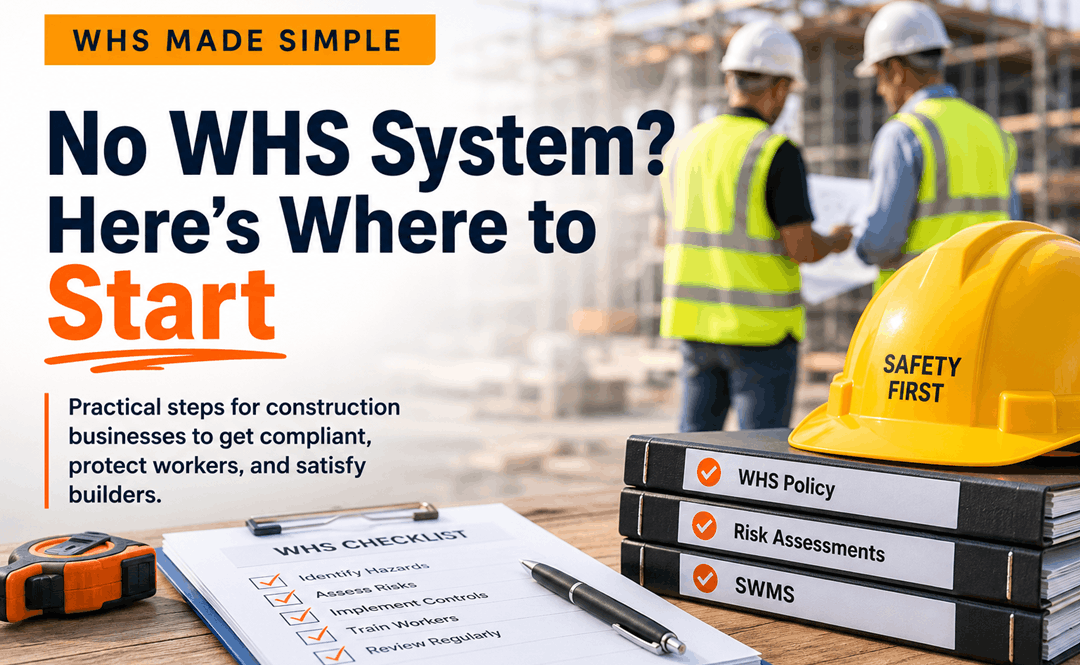
We Just Won a Project... But We Don't Have a WHS System
It's a situation many construction businesses find themselves in.
You've secured a new project, the builder asks for your WHS documentation, and you suddenly realise your existing paperwork isn't enough or worse, you don't have a formal WHS system at all.
Whether you're a builder, subcontractor, demolition contractor, civil contractor, or trade business, having a practical Work Health and Safety (WHS) system is no longer optional. Principal contractors, developers, government projects, and commercial clients increasingly expect businesses to demonstrate they have effective safety systems in place before work begins.
The good news is that building a WHS system doesn't have to be overwhelming. The key is creating a system that reflects how your business actually operates, rather than relying on generic templates that rarely get used on site.
In this guide, we'll explain where to start, what documents you need, and how to develop a WHS system that helps your business stay compliant while supporting safer and more efficient project delivery.
Why Every Construction Business Needs a WHS System
Many contractors assume WHS systems are only necessary for large companies.
In reality, every construction business has legal obligations under Australian WHS legislation. More importantly, many builders and principal contractors won't allow contractors onto the site without appropriate safety documentation.
A practical WHS system helps your business:
- Meet Australian WHS obligations.
- Demonstrate professionalism to builders and clients.
- Reduce workplace risks and incidents.
- Prepare for SafeWork inspections.
- Improve success when tendering for larger projects.
- Build confidence with workers and clients.
- Protect directors and business owners from unnecessary WHS risks.
A good WHS system isn't just about compliance; it supports smoother project delivery and stronger business growth.
Signs Your Business Needs a WHS System
If any of these situations sound familiar, it's time to put a structured WHS system in place.
Many principal contractors review SWMS and supporting documents before allowing contractors onto the site.
Generic, incomplete, or outdated documents are often rejected, delaying project commencement.
Commercial builders, developers, and government projects often require evidence that your business has an established WHS management system.
Without one, your submission may not progress.
As your workforce expands, informal safety processes become difficult to manage consistently.
Documented procedures help maintain safety standards across multiple sites and teams.
Many organisations require contractors to demonstrate structured safety management or work towards ISO 45001 certification before awarding contracts.
A strong WHS system forms the foundation.
If SafeWork attends your workplace, you'll need to demonstrate how hazards are managed and safety procedures are implemented, not simply produce paperwork.
What Happens If You Continue Without a WHS System?
Many businesses only think about safety systems after they encounter a problem.
Operating without a structured WHS system can result in:
- Builders refusing site access.
- Delays while preparing documentation.
- Lost tender opportunities.
- Failed compliance audits.
- Increased WHS risk exposure.
- Inconsistent safety practices across projects.
- Greater legal responsibility for directors.
These challenges often cost significantly more than implementing a practical safety system from the beginning.
How to Build a WHS System for Your Construction Business
Rather than creating dozens of documents at once, focus on building a practical framework that grows with your business.
Every construction business is different.
Start by asking:
- What work do we perform?
- What hazards do we regularly encounter?
- What high-risk construction work do we undertake?
- What equipment do we use?
- Who works on our projects?
Your WHS system should reflect your day-to-day operations—not someone else's.
Identify the hazards associated with your work.
Common construction hazards include:
- Working at heights
- Mobile plant and machinery
- Excavations
- Electrical work
- Manual handling
- Traffic management
- Confined spaces
- Demolition activities
Once hazards have been identified, assess the risks and implement appropriate control measures.
A WHS system is much more than a folder full of documents.
It should clearly explain how work is completed safely.
Typical procedures include:
- Hazard reporting
- Incident reporting
- Risk assessments
- Worker consultation
- Site inspections
- Emergency response
- Contractor management
- Plant and equipment inspections
The easier these procedures are to understand, the more likely workers will follow them.
Safe Work Method Statements (SWMS) are among the most important documents on construction sites.
Avoid relying solely on generic templates.
Instead, develop SWMS that accurately describe:
- The work being performed.
- Site-specific hazards.
- Equipment being used.
- Control measures.
- Worker responsibilities.
Builders are far more likely to approve documentation that reflects actual site conditions.
Even the best WHS system won't improve safety if workers don't understand it.
Provide:
- Site inductions
- Toolbox talks
- SWMS reviews
- Equipment training
- Emergency response training
Workers should understand both the documentation and how it applies to their daily work.
Your WHS system should become part of everyday operations.
This includes:
- Conducting regular site inspections.
- Recording toolbox meetings.
- Reporting hazards.
- Investigating incidents.
- Updating SWMS as work changes.
Safety documentation should support the work—not become paperwork that nobody uses.
Construction projects constantly change.
Regularly review:
- Procedures
- Risk assessments
- Incident reports
- Worker feedback
- Inspection findings
Continuous improvement helps ensure your WHS system remains practical, compliant, and effective.
Common Mistakes When Implementing a WHS System
Many businesses unintentionally weaken their safety systems by making avoidable mistakes.
Templates can be a useful starting point, but they should always be customised to reflect your business and project risks.
A WHS system only works when workers understand and use it.
Practical implementation is more valuable than having hundreds of pages of documentation.
Construction safety happens on site.
Your documentation should support supervisors and workers—not create unnecessary paperwork.
Projects evolve, hazards change, and procedures should change with them.
Regular reviews keep your system relevant.
Many contractors only begin preparing safety documentation after a builder requests it.
Having your WHS system ready beforehand helps avoid delays and demonstrates professionalism.
What Should a Practical WHS System Include?
Although every business is different, a practical construction WHS system commonly includes the following:
| Document | Purpose |
|---|---|
| WHS Policy | Demonstrates management's commitment to safety |
| Risk Register | Identifies workplace hazards |
| Risk Assessments | Evaluates workplace risks |
| Site-Specific SWMS | Controls high-risk construction activities |
| Incident Reporting Procedure | Records and investigates incidents |
| Emergency Procedures | Guides emergency response |
| Site Inspection Checklists | Monitors ongoing compliance |
| Training Records | Demonstrates worker competency |
| Consultation Records | Documents worker involvement |
| Corrective Action Register | Tracks improvements and outstanding actions |
The exact documentation required will depend on your business activities, workforce, and project requirements.
What Makes a WHS System Effective?
The most successful WHS systems aren't necessarily the largest.
They're the ones that workers actually use every day.
An effective system should:
- Reflect how your business operates.
- Be easy for supervisors to implement.
- Support compliance with Australian WHS legislation.
- Help builders quickly review documentation.
- Prepare your business for audits and inspections.
- Grow alongside your business.
When safety systems become part of everyday operations, they deliver value well beyond compliance.
Why Construction Businesses Choose Solving Safety On Site
At Solving Safety On Site (SSOS), we work exclusively with builders, subcontractors, and high-risk construction businesses that need practical safety systems, not generic paperwork.
We develop site-ready WHS systems that reflect how your business operates and meet the expectations of builders, principal contractors, and SafeWork inspectors. Whether you need customised SWMS, support for audit preparation, ISO certification assistance, or a complete WHS management system, our solutions are designed for real construction environments.
Rather than creating documents that sit on a shelf, we help businesses implement practical systems that improve compliance, support safer worksites, and provide confidence when tendering for new projects.
Can a small construction business operate without a WHS system?
Every business has WHS obligations under Australian legislation. While smaller businesses may require a simpler system, documented safety processes are essential for managing risks and meeting client expectations.
Is a WHS system the same as ISO 45001?
No. A WHS system is your business's framework for managing workplace health and safety. ISO 45001 is an internationally recognised standard for occupational health and safety management systems.
Can I use free WHS templates?
Templates can provide a starting point, but they should always be customised to reflect your work activities, hazards, and project requirements.
How long does it take to implement a WHS system?
The timeframe depends on your business size, existing documentation, and the complexity of your operations. Businesses starting from scratch typically require more planning than those improving existing systems.
What happens during a SafeWork inspection?
Inspectors may review your documentation, observe work practices, speak with workers, and assess how effectively risks are being managed. A practical WHS system helps demonstrate your commitment to workplace safety and compliance.
Build a WHS System That Works in the Real World
If your construction business doesn't yet have a WHS system, there's no better time to start. A practical system can help you meet legal obligations, satisfy builder requirements, improve tender opportunities, and create safer worksites.
At Solving Safety On Site, we help construction businesses develop WHS systems that work in real project environments, not just on paper. Whether you're building a system from the ground up or improving your existing documentation, our team can provide practical guidance tailored to your business, helping you stay compliant and ready for your next project.