
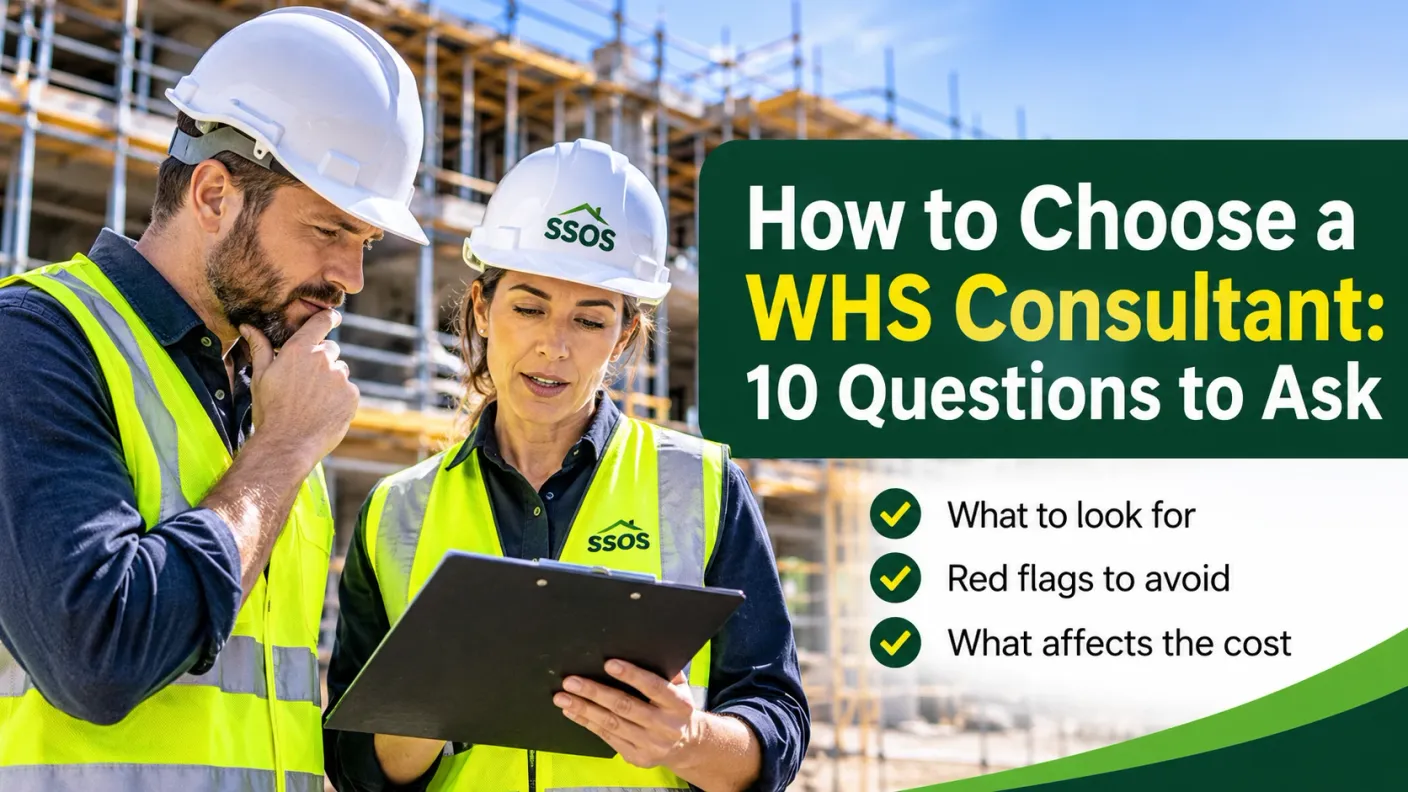
The right WHS consultant leaves your construction business safer and better organised than they found it. The wrong one leaves you with a folder of templates nobody opens. For a builder, principal contractor or trade business owner, that difference shows up fast: in how your crews work, how you handle a SafeWork NSW visit, and whether you win the next tender.
Most businesses start looking when something forces it: a new project needs a safety management system, a principal contractor asks for prequalification evidence, or an incident exposes a gap. That's exactly when the choice matters most. This guide covers what a good consultant should do, the ten questions to ask before you hire, the warning signs to walk away from, and the factors behind WHS consultant cost.
Key Takeaways
- A good WHS consultant understands construction risk, reviews your existing systems, writes relevant procedures and SWMS, and backs it with real site support.
- Site inspections matter because your documentation has to reflect what actually happens on site, not a template.
- Walk away from anyone selling generic templates as a "system" or promising "guaranteed compliance".
- WHS consultant cost depends on your business size, number of sites, SWMS required, inspections and whether you want ongoing support.
- For most small and mid-size builders, a consultant gives flexible access to specialist support without a full-time safety hire.
What Does a WHS Consultant Do?
A WHS consultant helps you find your workplace health and safety risks, tighten your safety management system, and put practical controls in place. In construction, that's a lot more than writing documents. A good one understands how the work is really performed (the access problems, the plant, the subbies, the high-risk activities) and manages the risk in that real setting, not on paper.
Depending on what you need, that can include:
- WHS management system development and review
- SWMS preparation and review
- Site and workplace inspections
- Risk assessments and hazard identification
- Safety procedures, policies and documentation
- Compliance audits and clear recommendations
- Principal contractor prequalification support
- Ongoing WHS advice and system improvements
The aim is a system your workers and supervisors can actually follow, and one that leaves your business able to manage WHS on its own. For the bigger picture, see our guide on how a WHS consultant strengthens your safety system.
Construction is consistently one of Australia's highest-risk industries for serious workplace injury and fatality, according to Safe Work Australia industry injury and fatality data.
Signs Your Business Needs a WHS Consultant
You won't need outside help every day. But a few situations are a clear prompt to review your arrangements:
- You're preparing for a construction tender: the client or principal contractor wants a WHS management system, safety documentation or prequalification evidence.
- Your SWMS are generic or out of date: they don't match the real work activities, hazards and controls on the job.
- You've had an incident or near miss that has pointed to a gap in how you manage safety.
- You're growing fast: more workers, more subbies and more sites mean more to manage.
- Nobody really owns WHS: safety is shared informally, with no process for checking and improving it.
If several of these ring true, that's the signal to act.
10 Questions to Ask Before Hiring a WHS Consultant
Ask these before you sign anything. The answers show quickly whether someone understands construction or just sells safety documents.
1. Do you specialise in construction WHS?
Construction sites carry risks, activities and duties that office WHS never touches: high-risk construction work, plant, subcontractors, principal contractor obligations. Ask whether they've worked with builders, principal contractors and trades, and look for hands-on site knowledge rather than experience limited to writing general safety documents.
2. How well do you know NSW WHS legislation?
If you work in New South Wales, your consultant should know the NSW Work Health and Safety Act and Regulation, the relevant codes of practice, SafeWork NSW guidance and who holds which duty. Ask how they keep that current. And listen to how they explain it: a good one can put compliance in plain language and tie it straight to your operations.
3. What qualifications and industry experience do you have?
Both the paper and the practical matter. Ask about:
- Relevant WHS qualifications and training
- Membership of a professional body such as the Australian Institute of Health & Safety
- Experience supporting construction businesses
- Site inspections, audits and safety systems they've actually run
- Familiarity with the kind of projects you take on
Experience on the tools or on site usually shows up in how relevant the advice is.
4. Will you visit our construction sites?
This is the one that sorts the field. A consultant working only from their desk can spot documentation issues, but they'll miss the hazards and shortcuts you only see on site. Visits let them watch the work, check whether your SWMS match what's really happening, talk to supervisors, and recommend fixes that fit. Ask how often inspections are included. Safety advice should reflect the site, not just the paperwork.
5. Can you prepare and review SWMS for our high-risk work?
High-risk construction work needs a Safe Work Method Statement that matches the task, not a template with your logo on it. Ask how they approach SWMS writing and management, how documents get reviewed, and how they're updated when the work or the site changes.
6. Can you help with principal contractor prequalification?
Chasing bigger jobs means proving your safety system before you win the work. That usually covers WHS management systems, policies and procedures, SWMS and risk assessments, training records, incident processes and audit evidence. Ask whether they've prepared this kind of documentation for tenders before, and whether they can show what passes.
7. Will the system be practical for our workers?
A system only works if people use it. When the paperwork is too complicated, it quietly gets ignored. Ask how they keep it usable: clear procedures, simple checklists, SWMS that make sense, and digital compliance solutions your supervisors can run from a phone. The goal is safety built into the day, not a scramble before an audit.
8. How do you calculate your fees?
Fixed project fee, hourly rate or ongoing retainer? Pin it down early, and get clear on what's included: are site inspections part of the price, are documentation updates extra, is travel charged separately, is there a minimum contract period? Ask for a written scope. Comparing on headline price alone is misleading, so weigh the services, experience and site support that come with it.
9. What support do you provide after the first review?
A review is the start, not the finish. A list of problems is only useful if someone helps you fix them: correcting documentation gaps, updating procedures, improving SWMS, putting controls in place and getting you audit-ready. It helps to understand how safety management consultants work, step by step so you know what you're paying for after that first visit.
10. Can you show similar construction projects?
Past work tells you whether a consultant gets businesses like yours. Ask for examples from your trade and your kind of sites. If you run cranes or lifting work, look for that experience specifically, like our WHS support for a crane and lifting business. Relevant, named work beats a general claim to be a safety expert.
Red Flags to Watch For
Knowing what to avoid matters as much as knowing what to look for. Be cautious if a consultant:
- Leans entirely on generic templates, handing over documents without understanding your work or your site.
- Promises "guaranteed compliance". Nobody can guarantee that.
- Won't visit sites or ask how your business actually runs.
- Is vague on pricing, with services, extras and responsibilities not in writing.
- Only talks documentation, with no practical help implementing controls or managing risk.
- Wants a long lock-in up front, before they've assessed a thing.
A professional should be upfront about their services, their limits and their pricing.
What Affects WHS Consultant Cost?
The question everyone asks is how much it costs, and there's no single rate. Anyone quoting one before they understand your business is guessing. The price moves with:
- Business size and number of sites: one location is a different job from a contractor running several active sites.
- Your existing documentation: reviewing and improving a system you already have takes less work than building one from scratch.
- How many SWMS you need: more high-risk activities mean more task-specific statements.
- Site inspections and audits: the more visits, the more consulting time.
- Ongoing support: a one-off review costs differently from regular help through the year.
Before you compare quotes, make sure each one comes with a clear written scope, so you know exactly what you're paying for.
WHS Consultant vs an In-House WHS Officer
Hire a consultant, or employ someone full-time? It comes down to your size, your sites and your budget. Here's the trade-off at a glance:
| Comparison | WHS consultant | In-house WHS officer |
|---|---|---|
| Cost | Pay for what you use | Full-time salary and on-costs |
| Expertise | Broad, across many sites and trades | Deep knowledge of your business |
| Availability | Scheduled visits and agreed support | On site during working hours |
| Independence | Outside view, harder to ignore | Part of the team |
| Best suited for | Small and mid-size businesses, or project peaks | Larger, multi-site businesses |
For most small and mid-size construction businesses, a consultant covers the gaps without a permanent hire, and you can lean on them heavily at the start, then scale back to check-ins. Larger operations often run an internal WHS professional, with a specialist brought in when needed.
How SSOS Helps Construction Businesses
Solving Safety On Site (SSOS) are construction safety consultants in Sydney who work the way the questions above suggest: on site, in plain English, building systems crews will actually use. We review your WHS system and documentation, walk your sites, write SWMS that match the work, run compliance audits, and help with principal contractor prequalification.
Our services include WHS management system reviews and development, construction site inspections, SWMS development and review, safety documentation, compliance audits, prequalification support and ongoing WHS advice. For the detail, see our WHS consulting for construction page.
Not sure where your safety system stands? Start with a free WHS system review. We'll flag the obvious gaps and give you the practical next steps, with no obligation. Book a free WHS system review.
Frequently Asked Questions
What does a WHS consultant do?
A WHS consultant reviews how you manage health and safety, finds the hazards and gaps, prepares safety documentation, develops procedures and recommends practical fixes. In construction that also covers SWMS, site inspections, audits and prequalification support.
Does a small construction business need a WHS consultant?
Not always for ongoing support. But one is worth it when you're preparing for a tender, building a safety management system, reviewing SWMS, or closing gaps in your current WHS arrangements.
Is hiring a WHS consultant a legal requirement in Australia?
No. Engaging a consultant isn't a legal requirement. But every business and duty holder must meet their WHS obligations, and hiring a consultant doesn't transfer or remove those responsibilities. It just helps you meet them.
How much does a WHS consultant cost?
It varies with business size, the number of sites, how complex the work is, the documentation needed and the level of ongoing support. Ask for a written quote based on your actual requirements rather than a headline rate.
Can a WHS consultant help with ISO 45001 certification?
Yes. An experienced consultant can help you build and improve a safety management system in line with the ISO 45001 standard: documentation, risk processes, internal audit prep and system improvements. Certification itself is done by an independent certification body. Our ISO certification guide explains what's involved.
What should I prepare before contacting a WHS consultant?
Have a rough picture ready: your work activities, current WHS documentation, number of workers and sites, high-risk activities, and any upcoming tender or prequalification requirements. It helps them understand your needs and recommend the right support.
How do I choose the right WHS consultant for my business?
Look for real construction experience, knowledge of the WHS laws that apply to you, genuine site-inspection capability and a track record building safety systems. Then ask about services, pricing, past projects and ongoing support before you decide.
Final Thoughts: Choose a Consultant Who Understands Construction
Choosing a WHS consultant is about more than finding someone to write safety documents. You want a professional who understands construction, recognises the practical risks on site, and can build a system that works in everyday operations. Ask the ten questions above, check their experience, get the pricing in writing, and you'll know within the first conversation whether they're the right fit.
Book your free WHS system review to see where your safety system stands.